With the ever-increasing climate change, there are substantial concerns about crops facing numerous abiotic stresses. Such abrupt alterations in the environment profoundly affect soil microbes and lead to the development of unusual and novel plant-microbial interactions that influence the plants themselves. While pathogenic viruses challenge crop physiology and reduce crop
Continue readingCategory: Special issue
Call for articles – Root-soil-leaf interplay: strigolactone signaling in plant-microbe interactions
This Special Issue explores the intricate roles of strigolactones in mediating interactions between plants and soil microbes, focusing on their implications for sustainable agriculture and ecosystem health. First, understanding the roles of strigolactones in mediating plant-microbe interactions is crucial for deciphering the complex relationships that underpin ecosystem dynamics. These
Continue readingCall for articles – Genome editing for improving plant stress tolerance: challenges and opportunities
NEW DEADLINE. June 30, 2026 Agricultural productivity is increasingly jeopardized by abiotic stresses such as drought, salinity, and extreme temperatures, as well as biotic stresses like pests and pathogens. These challenges are further exacerbated by climate change, which intensifies environmental variability and resource scarcity. Conventional breeding approaches often fall short
Continue readingCall for articles – Root responses to multifactorial environmental constraints
Roots naturally encounter a variable chemical, physical and biotic environment in time and space. If these environmental factors exceed the normal range overcoming plant adaptive capacity, they are considered as stressors challenging plant fitness. There is currently a gap between our mechanistic understanding of plant responses to variation of single
Continue readingSpecial Issue based on the European Congress of Photosynthesis Research (Invitation Only)
CALL FOR ARTICLES – Gasotransmitters in plant development and stress acclimation: recent avenues in their research
The role of NO, H2S and CO on plant developmental processes has recently emerged. They regulate seed germination, nodule formation and nitrogen fixation, reactive oxygen species, Ca and hormone signalling, and their subsequent impact on plant development under stress and non-stress conditions. This special issue aims to compile emerging and
Continue readingCall for articles – Polar, alpine and mountain plants in climate change
SUBMISSION DEADLINE: December 2024 Extreme latitudes, like those of Arctic and Antarctic areas, share several features with mountain habitats, like short growing seasons with seasonally high solar irradiation, mostly cool temperatures and rugged terrains. Relatively rich flora can still be found especially in some of the Arctic and mountain regions
Continue readingCALL FOR ARTICLES – Light on Flowering: the role of light spectrum in regulating flowering in horticultural crops
!! NEW SUBMISSION DEADLINE: 28 February 2025 Horticultural crops, including fruits, vegetables, ornamental plants, medicinal herbs, and aromatic spices, are pivotal in addressing diverse agricultural needs. Recent advances in understanding how different light spectra influence flowering in horticultural crops, especially with LED technology, have created new research opportunities, especially
Continue readingSpecial Issue “Biostimulants in Agriculture” – Deadline July 2024 -Congress Participants Only
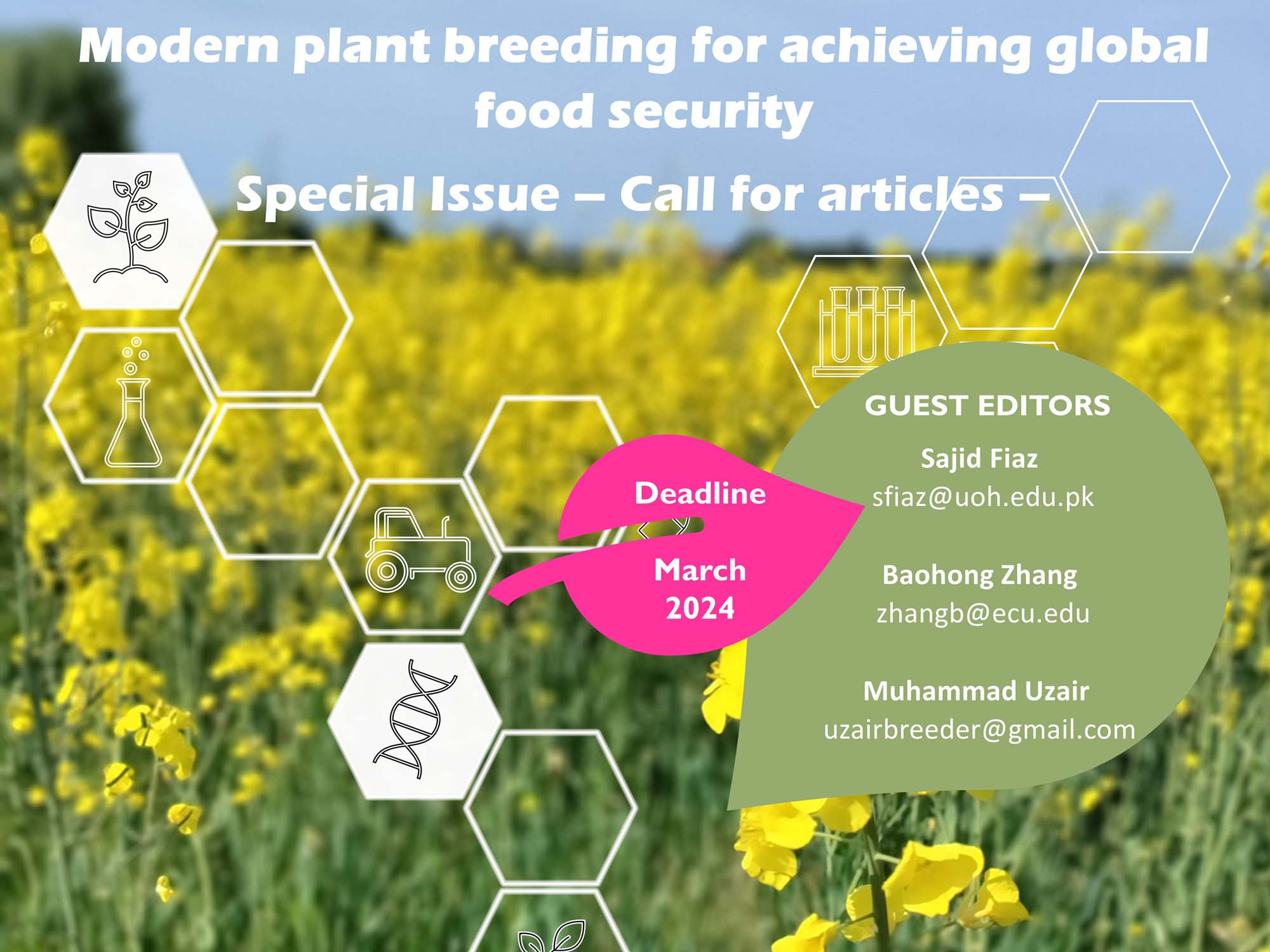
Call for articles – Modern plant breeding for achieving global food security
Food and Agriculture Organization has estimated that the global human population will reach approximately 9 billion by 2050. The world farming system must produce 50% more food than the current production to meet growing food demands. Plant breeding-based technologies have contributed significantly to hunger reduction during the last few decades.
Continue readingCall for articles – Role of phytohormones and plant-growth regulators in the regulation of plant immunity
DEADLINE CHANGED TO 31st MARCH 2024. Pathogenic microbes are responsible for enormous crop loss during pre and post-harvest storage conditions and, thus, are one of the major threats to sustainable crop production. In particular, fungal pathogens cause some of the most devastating diseases of staple crops, including blast disease of
Continue readingCall for articles – Large-scale data approaches in non-model species
NEW SUBMISSION DEADLINE: April 2024 This special issue focuses on data resources and computation approaches for non-model organisms. In the past decade, there has been a revolution in high throughput methods. This has liberated studies from the need to use model systems, as evidenced by the explosion in available genome
Continue readingCall for articles – From water to land: Which factors drove plant terrestrialization?
Some 500 million years ago plant life on land started to flourish and diversify. This transformative event required the ability to resist to earth’s challenges—abilities hard-wired in extant plants today. Some prerequisites for terrestrial life already evolved in streptophyte algae, thus offering building blocks and networks that enabled adaptation to
Continue readingCall for articles- From the biosynthesis of volatiles and colors to their role in eco-environments-CLOSED
Plant-specialized metabolites, including anthocyanin and carotenoids, and floral volatiles such as terpenoids, phenylpropanoids/benzenoids, and fatty acids play crucial roles in plants. Importantly, they are features of flowers’ colors and fragrance, which are essential traits in maintaining the ecological linkage between flowers and a diverse range of visitors, such as pollinators,
Continue reading-Call for Articles-Plant sugar metabolism, transport and signaling in a challenging environment-CLOSED
Sugars are the main source of carbon and energy in all living organisms. While sugar metabolism, transport and signaling are key processes involved in biomass production, yield and quality, sugars also play a crucial role in the adaptation of plants to the environment. Over the past decades, these fields have
Continue reading